Showing posts with label China. Show all posts

Thursday, 1 October 2015

Glass adventures

My admiration for glass as a material increases daily.  Which is not to say that I think all applications of this extraordinary material are equally virtuous.  But then again, virtue has never been enough to define good architecture.  Heightened emotion might be closer to the mark, and glass has a great way to create some pretty extreme emotions. 

Apparently death-defying transparent floors at great heights are not altogether new.  But I have to say this one, on a slender suspension bridge in China, makes more sense, than most.

Brought to you by inhabitat.com,with a text reflecting their usual casual approach to technical detail, the picture gallery is enough to suggest the awe inspiring thrill that the original timber planked bridges must have inspired in generations of tourist pilgrims.

My previous post about glass was the proposed swimming pool spanning some 25m between luxury apartment blocks at Embassy Gardens in London.  It interests me to speculate why I feel so strongly that there is an ethical as well as aesthetic comparison to be made between the two projects.  Yet the contrast comes sharply to mind, in spite of the fact that I made a case for some virtue in the London project.

The London pool is an impressive but perverse piece of material engineering.  But it is fair to ask: Why hold up many tons of water in mid air, for a haptic experience probably indistinguishable from an infinity edge pool conventionally supported?  And let's face it, the pool is only a rendering at the moment, promoting a developer's real estate sales.

In contrast, the Chinese suspension bridge is an elegant technical response to context and history, and guaranteed to maintain the thrill for the entire journey.  It ticks the boxes for a great use of glass in architecture.


Monday, 16 March 2015

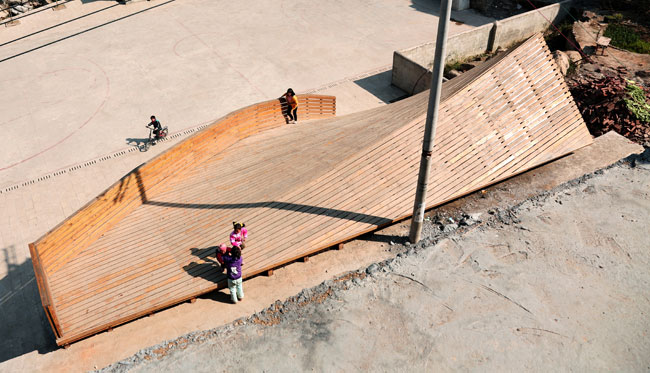
Real parametrics


Sometimes you come across a project that re-establishes your faith in the purpose of architecture, while it also accommodates the architects' in-group preoccupation with interesting forms which dominates the mainstream literature. This little project is one of those classic NGO interventions – in a place where almost anything is valued, but where something good adds immeasurably more value. 

Friday, 17 May 2013

One Building, One City

It has been a while coming, and it has been difficult to believe.  The next world's tallest building will be in an empty field in China, it will be prefabricated and constructed in an unprecedentedly short time, and it will not be built primarily as an expression of financial power.

If you don't pay attention to detail, you might be tempted to come to the opposite conclusions, and classify it away with a lot of other hype.  But in fact, this is one of the most plausible, most genuine, most radical contributions to the transformation of the planet through a reasoned application of available technology.  The proponent of the scheme is a visionary industrialist who is putting his money where his mouth is, and equally importantly, has demonstrated the capacity to bring the project to fruition.

Friday, 25 May 2007

Green building in China

Since it was granted the right to host Olympics in 2001 China has been developing green policies. While this was at first largely a response to the fact that the Sydney Olympics had established environmental sustainability as a ‘third tenet’ of the international Olympics movement, the momentum towards more responsible attitudes to the environment has been building recently.

Green building has been given importance in both China’s 11th Five-Year-Plan and its medium and long-term plan for science and technology development. As noted by Austrade, the Australian agency charged with developing exports in goods and services, some outcomes of this elevated emphasis include:

  • The government will invest approximately US$400 billion on energy efficiency projects before 2010.
  • The government has launched an ambitious plan to renovate existing buildings to make them more energy-efficient. Twenty-five per cent of the buildings in medium-sized cities and 10 per cent of those in small cities will be refurbished by 2020.
  • The government has also indicated it will announce tax rebates and other financial incentives for the construction and purchase of energy efficient buildings in the future.
  • There are 11 'Green Cities' and 140 'Green Building' projects under construction. Australian consultants are scrambling to be involved, and their ability to compete with other international consultants is in no small part due to Australia’s relatively long commitment to developing the tools and regulations for energy efficiency and other sustainability measures in buildings.

How ironic therefore to contrast the scope of China’s initiatives, with the miniscule spending by the Australian government on its much trumpeted Solar Cities program (see my last post), and how disturbing that Prime Minister Howard has again suggested that Australians will have to choose at the next elections between more stringent green policies put forward by the opposition parties, and economic viability.

China is more usually seen as the dirty bogey man willing to endure environmental degradation. Given that even the Chinese government has realised that environmental degradation and energy waste are obstacles to China’s economic growth, I can only wonder how long it will take our blinkered government to come to the same conclusion.

Read the Austrade briefing here:
http://www.austrade.gov.au/Green-building-to-China/default.aspx.