Showing posts with label Zaha Hadid. Show all posts

Friday, 28 February 2014

It wasn't me too: Deaths in Qatar

Some time back, I used the Bart Simpson trademark denial of responsibility as the headline of my post about Rafael Viñoly and his apparently disingenuous attitude to the infamous 'Walkie Talkie building' in London, which has been wreaking havoc with its surroundings.  My beef in that post was first the recurring incompetence apparently considered acceptable in the architectural profession, and second the unconscionably cavalier attitude of that particular star architect.

I didn't expect to have to return to the second of those themes quite so soon, and with quite such a grim reason.  But recently Zaha Hadid managed to rile me and sadden me, far beyond the usual, as the general plight of migrant workers in the Gulf came into dramatic focus around deaths in Qatar's building industry.

In brief, the deaths of Indian and Nepali workers in the metaphorically and literally overheated construction frenzy of that small country are running at several hundred a year, made worse by the build-up to the World Cup football tournament in 2022.  As reported by Dezeen, Zaha Hadid appears to have declared herself not responsible in any way, a declaration apparently made necessary in her mind by the very high visibility of her signature stadium for that event:
"It's not my duty as an architect to look at it," Hadid said yesterday at the reopening for her Olympic aquatics centre in London. "I cannot do anything about it because I have no power to do anything about it. I think it's a problem anywhere in the world. But, as I said, I think there are discrepancies all over the world."
It would be silly to over-simplify the issue.  Hadid might be driven by some clarity of thought, useful to make clear the attribution of blame between professional consultants involved in the design and documentation of a major project, and unscrupulous construction contractors operating in a politically corrupt environment made worse by culturally entrenched dehumanizing attitudes. It is almost tempting to give her credit for that, and to see her statements as helping to highlight the necessary, if difficult reforms.  But only almost tempting.  Because she is wrong on at least two counts.

The first is ethical, if subjective.  If the reporting is to be taken as accurate, Hadid comes across as crass and callous.  Her attitude reinforces in the public mind the more general perception of architects as arrogant and uncaring.

The second is objective.  Architects are responsible in common law for the buildability of their designs.  The London Olympics proudly claims that there was not a single fatality on any of its building sites, and that can be achieved only within regulatory frameworks where there cannot be a disconnect between the design and the construction practices necessary to realize it.  This concept has progressed so far in developed nations that in New South Wales, Australia, 'projects have to meet safe design requirements including provision of a safe design report and/or information on how the designer has designed the structure to be without risk to health and safety'

In Qatar, the deaths are not all from site accidents, they include other causes like heart attacks caused by over-exposure to the extremely hot conditions, and even factors related to insanitary worker accommodation. Commentators have also pointed to the role of governments of the workers' home countries, in as much as the attitudes to worker safety and welfare may be no better back home.  The problem is complex, and no single architect should be asked to shoulder the blame, even symbolically.  But an estimated 4000 likely deaths by the time the first ball is kicked in 2022 is a horrifying prospect, and one to which there should be more compassionate and proactive responses by architects.  As Dezeen reports:
Other well-known architects have previously spoken out over conditions for workers in foreign nations. Richard Rogers says that “architects have a responsibility to society“, while Daniel Libeskind called on architects to consider whether their projects are “legitimate.”
See the Dezeen article here.
Much of the investigative reporting and commentary has been in the Guardian newspaper.  Start here.
For a range of careful but formulaic responses from other UK based major consultants, see this article in Building magazine.

Tuesday, 16 July 2013

I think, therefore I dwell


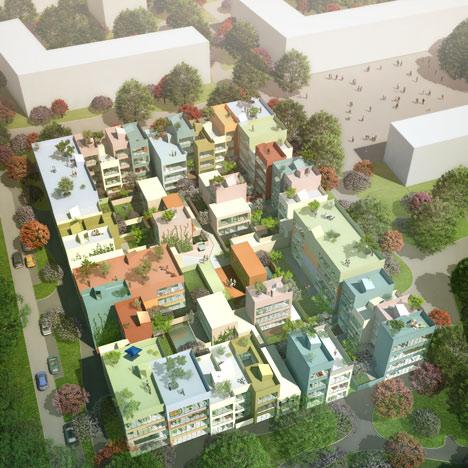
Forgive the pathetic attempt to invoke both Descartes and Heidegger in the one catchy title.  It was prompted by the current front page of Architizer.com announcing that MVRDV has recently won the Feldbreite competition to design an apartment block in the Swiss city of Emmen.  Well, not exactly an apartment block.
"The Dutch firm deviated from the expected by delivering designs for 95 units across 16 different housing typologies ranging from apartments to townhouses. These are grouped around common gardens planted with fruit trees, giving a sense of community while each unit is painted a different color to emphasize individuality community."
And they did it in an unmistakable throwback to the Cartesian exercises of mid-twentieth century modernism, the variety and interest a painless outcome of the infinite opportunities of a thoughtful use of the three dimensional grid. I guess liking it makes me an unreconstructed modernist. But I stress that it is the modernism of the late le Corbusier, the one who remembered the lessons of his journey to the east, and polemicized not the universal sterility of the International Style, but the more satisfying, more organic forms of buildings and settlements.
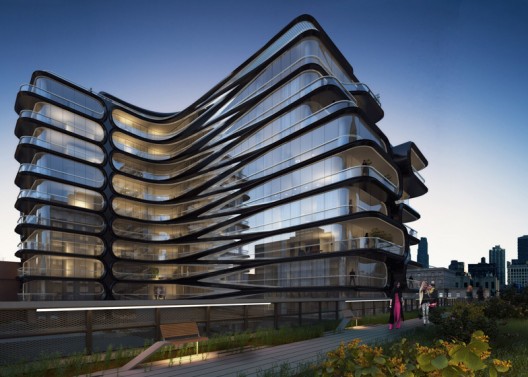
As usual, this was brought home to me not by the main focus of the page on the MVRDV scheme itself, but by the headline in the same issue: Finally! Zaha Gets Her First New York City Commission, drawing attention to an image (and I use the word advisedly) which couldn't be a greater contrast.

It's a dead give-away of my 1960s training, that I look at 'negative space' as a diagnostic of successful composition, of what might be said about a building in terms of its urban design engagement, of whether it is a manifestation of anything more than a 'look at me' syndrome.

And so I see in Hadid's lumpen curves the acres of shapeless glass as an ephemeral separation between the goldfish interiors and nowhere.  MVRDV's design, in contrast, appears to create all those fractal layers of the most engagingly public through to the most intimately private, while apparently not needing any more 'interest' than a few splashes of forgivingly renewable colour.

One scheme speaks eloquently about sustainability, without having to mention the word, while the other brays its disdain for anyone but the irresponsible few.  I wonder which will get the more breathless exposure in the design media? 

For more on the MVRVD housing scheme, including plans and schematics, click here.
For more about Hadid's condo for the Don Draper lifestyle, click here.  But you will find only the usual drivel, graced by a photo of the woman herself, bigger than that of her proposed building.

I'd love some feedback.
 

Sunday, 9 June 2013

Sustaining wealth: Hadid does Miami

I posted some time ago on The Antilla, the $1 billion high rise urban palace in Mumbai built for India’s richest man Mukesh Ambani (Obscenity makes me turn green), and tried to temper my contempt of the gross profligacy by pointing out that in a perverse way, such a private home in such a society may lay claims to a form of social sustainability.  It was a serious suggestion, made with my tongue firmly planted in my cheek, if readers can tolerate the ambiguity. 

I am a child of the mid-twentieth century, when social housing carried most of the burden of rhetoric for modern architecture.  So I cannot bring myself to be entirely serious in advocating a 'trickle down effect', as an acceptable solution to sharing equitably the limited resources of this planet.  But still, I was trying mightily to draw attention to hidden layers in any serious discussion.  Not least that in the Indian context, the impoverished neighbours of the Ambani's obscene indulgence are, at the same time, intensely proud of the success it represents.

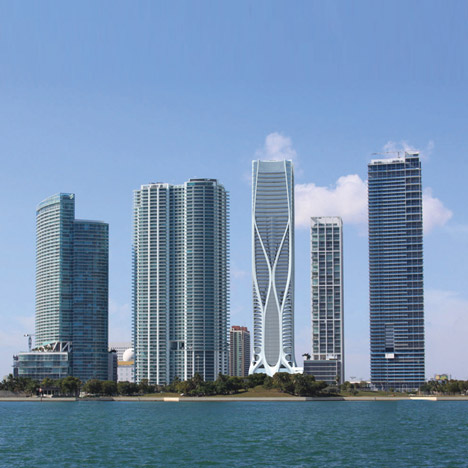
But the Antilla is a sigularity from which – notwithstanding how much it is a drastic local perturbation of the societynothing much can be generalised.  Not so with something like Zaha Hadid's first high rise in the western hemisphere, One Thousand Museum Tower proposed for the Miami waterfront.

As is becoming usual, Hadid displays a virtuosity in investing a building type with her challenging, apparently arbitrary curvilinear expression, that appears to emphasize a scale-free iconic formmotivated by artistic sensuality, and made possible by contemporary developments in parametric CAD/CAM fabrication.  That in this case the 'exo-skeleton'  is concrete just doubles the complexity, because the fabrication process has first to be implemented for the formwork, before it is manifested in the plastic shapes of the actual building.

But this post is not intended primarily as a critique of Hadid's contribution to "avoiding the generic modernist typology", as she is reported to have claimed.  I do find it interesting that she and her office are distinguished even in this field of gratuitous form generation, by taking delight in the emergent rather than the deterministic consequencesThus the references (in better descriptions of the project) to the variety of terraces and other detailed individual variations of the proposed apartments, which result from the continuously changing relationship between the 'exoskeleton' and the floor plates behind it.  Whether you warm to her personal aesthetic or not, like Frank Gerhy she is first and foremost a great architect.

Rather, what struck me on reading the announcements of the project, is what it represents.  As editorialised by ArchDaily:
"It is one of several (high rises) by high-profile architects that are beginning to take root in Miami, changing the tide of investment from real estate that is solely driven by location on the waterfront, to architecture that is high-end, luxury design."
That proposition barely begins to communicate the whole idea of 'luxury', in this time of supposedly depressed western economies and clarion calls for austerity heading into a new age of sustainable urbanism.  The real clues are in the detail. One Thousand Museum Tower makes room for 83 dwellings in its sixty storeys, sporting a wide range of amenities including private elevators, media rooms, and libraries.  Community amenities throughout the building also include a helipad, a deck with multiple pools and cabanas, rooftop event spaces, a cigar lounge, sun decks and billiards rooms, a fitness center and a screen room, according to the Architect’s Newspaper.  Oh, and almost missed it: at a price tag of up to $30 million a unit, the luxury apartments range from 5,400 square feet to 11,000 square feet. That's 540 to 1100 square meters.

I expressed concern some time ago about the 100 square meter per occupant, free standing MacMansions being built in Sydney, Australia, which makes them, on average, the biggest new houses in the world (See Mine's bigger than yours).  I shouldn't have worried so much about the unsustainable aspirations of middle class Australians.  The American Dream trumps us all every time.  Unfortunately, from the sustainability perspective, it is a nightmare.

Read ArchDaily for one of the more informative descriptions of One Thousand Museum Tower here.

Wednesday, 13 March 2013

It's probably architecture

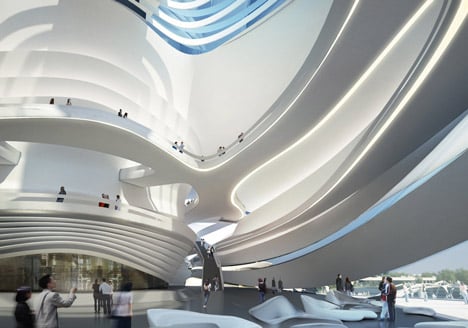
The latest large scale work by Zaha Hadid to feature heavily on archi-pop sites such as Architizer, Dezeen and ArchDaily is the Changsha Meixihu International Culture and Art Centre.

Architizer's headline Zaha’s Changsha “Megaplex” Is More Zaha Than We Can Handle hints at the possibility that this project, more than any other, might represent a tipping point.  But the actual tone of the article is sober and supportive, confining itself to a narrative that does no more than describe the formal development of the major components of this large complex.

In some respects, the published images indicate an architecture like many other proposals, by many other architects.  These works are clearly the products of visualisation software, and of the plastic sculptural freedom such software affords anyone who can lay out a rudimentary circulation diagram.  The illustrations are 'scaled' to human experience, by the same simple expedient as has always characterised architectural drawings: inserting the human figure in poses vaguely identified with the building program.  Any concern about the realism of the images as representing buildable prototypes is in the first instance answered by the now common knowledge, that the illustration software captures underlying geometric data which can be fed with little further mediation to fabrication software, in turn capable of controlling machines that automatically deliver suitable components at building scale.  There is no doubt that such buildings can be, and are being built.

So, do they represent the current parametric zeitgeist, a logical evolution of architecture outgrowing the artisan niche to which it was formerly adapted, or are there some other theoretical and practical implications that should be getting a better run in discussions on these sites?  Again, the first reaction might be that more profound theoretical examination is to be expected in the scholarly settings of books and academic journals.  Fair enough on the face of it, but a bit of a cop-out.

Even casual examination of the renderings suggests that their authors are simply not engaged in any rigorous anticipation of the built reality.  It isn't that hard to comment on the absence of material clues in these otherwise photorealistic renderings; the absence, rather than the dissolution of clues to what is inside and what is outside, the missing distinctions between surfaces formerly characterised as ground, wall, or sheltering roof.  More generally, this lack of coding of the layers of design intent leaves unanswered other profound questions relating to the life of the building, including how it actually achieves comfort and amenity, and whether it relies on sustainable supplies of energy to fulfill its most rudimentary functional tasks. The architects appear to be leaving that all to be somebody else's problem.

It is not a stretch to suggest that buildings like the Changsha Meixihu International Culture and Art Centre are the result of a relatively recent realisation – that really, almost anything is possible.  But is it good for us to leave that proposition hanging, without self-imposed constraints and qualifications?  Surely the theoretical discourse takes on an ethical dimension, in which even populist on-line magazines can engage?  Something to do with whether imposing on others the consequences of such wanton profligacy should be the dominant paradigm of public architecture?

Of course, there is much more to interrogating the theoretical underpinnings of an architectural proposal, than asking whether it is right or wrong to stretch budgets.  For me as a teacher, the implication of 'anything is possible' has very particular, everyday consequences – and many might be surprised that they are almost all negative.  Imagine trying to maintain a shared critical framework with a student, in which to communicate that not all is right with his or her developing studio design.  If students are seduced by Zaha in her 'anything is possible' mode, they have little incentive to accept such a critique.  While the concepts of 'right' or 'wrong' are contestable, to have no such concepts makes learning very difficult.