Showing posts with label photovoltaics. Show all posts

Wednesday, 1 November 2017

Architects' little helper

How to specify photovoltaics

Note: The Architizer guide to photovoltaics is accessible again. Apparently, it was accidentally taken down and took a while to restore.
It's been getting hard for the architectural aggregator sites to differentiate themselves. And of course, how to make money from similar content. 

Sooner or later, it had to become obvious that while many forums are now talking about architecture, and usually expanding into other branches of design as lifestyle accessories, few are focusing on how buildings really get made.

One of the older such sites, Architizer, has decided to focus on this new direction:
"Moving forward you can count on Architizer for the latest trends in practice, in-depth investigations into building-products and cutting-edge news on technology in our field.
Every week we will dive DEEP into a specific building-product, exploring how to specify it, who is pushing technological boundaries with it and how it can be used to create truly incredible architecture. We will work to answer some of the most frustratingly obvious questions that architects have, that seem to never get answered — how to stop a flat roof from leaking, how to make a door disappear or how to attach metal cladding to a building."
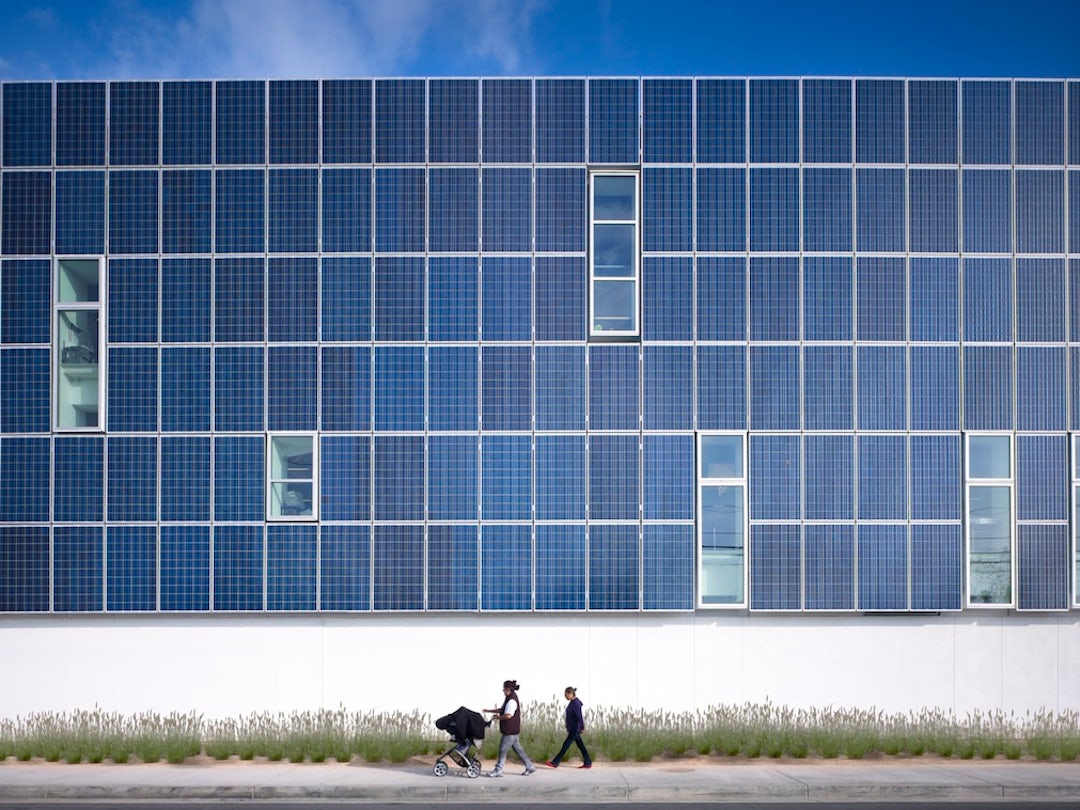
This week’s topic is photovoltaics. It is a technology that has been moving both slowly and quickly the same time. Photovoltaic panels have been available for at least 30 years. For most of that time, usually seen as the typical bolt on systems, oriented and tilted at an angle  determined by solar geometry, they have been perceived as inefficient and poorly integrated with the host architecture.

The need for building integrated photovoltaics has been long recognised.  Only in the last 10 years or so have there been enough built examples to fill a couple of case study books, and frankly, not many of the examples were particularly inspiring. But that has changed lately, with rapid advances in new materials for the photovoltaic cells themselves, and the ways of combining PV with conventional building materials.

The Architizer review article provides a convenient and timely update, with relatively comprehensive, and well-balanced technical detail.


Go to 'How to specify photovoltaics'

On that page, you will also find links to other articles in the same series.  And how do they make money out of it?  Well, if you need to, you can sign up for the Source, a service to connect specifiers with manufacturers.

Friday, 26 April 2013

Tipping point coming in photovoltaics?

A recent article in Engadget provides an exceptionally balanced and informative description of emerging technologies in the area of solar photovoltaic energy generation.  The amateur futurist in me is very tempted to suggest that we are seeing the first concrete evidence of a likely change of direction for renewables.

In the last few years, we have pinned a lot of hope on the evolution of PV to make possible building integration and distributed power generation.  Each is very attractive, the latter because it helps make the system potentially safe from single points of failure.

But there has always been a tension between that approach, and centralised systems feeding ever larger grids.  Wind power has gravitated towards 'bigger is better' because it is - bigger turbines are more efficient, and big wind farms are best located where the wind resource is the best.  With photovoltaics, big concentrator technologies have not had the same obvious compelling advantages.  But now it is emerging that they do have.

A team of IBM researchers in Switzerland is working on an implementation of a High Concentration Photovoltaic Thermal system, that will start with significantly greater electrical conversion efficiencies than BIPV technology.  But with well integrated thermal technology, it actually should be able to collect 80% of incoming sunlight and convert it to useful energy, while employing robust and low tech materials for its construction.

The actual solid state chips that do the electrical conversion remain high tech, as do the fundamentals of the extraordinarily effective cooling system, which is required to accommodate the heat generated by a concentration of 2000 to 5000 times the intensity of the incoming solar radiation. But the project team have thought through the rest of the system to replace expensive steel and glass with low cost concrete for the support structures, and simple pressurized metalized foils for the optics.

Emerging trends to district heating and even district cooling prompt the other synergies in the proposed technology.  The very high temperature fluid cooling is coupled with desalination or district heating potential, and with district cooling using absorption chillers.  Given thermal storage is already a well studied market, the promise of a centralised, but scalable solar/thermal generation is becoming very attractive.

IBM expects that the system would be approximately one third the cost third of current comparable technologies, but hasn't promised when the technology will emerge from its research phase to full prototyping.

Read more:


Thursday, 14 February 2013

Yes, Virginia, photovoltaics do work

One of the headline snippets in today's in inhabitat news blog is that world installed solar photovoltaic generating capacity has surpassed 100 gigawatts.  Good news enough in its own right. Read about it here.

But for me, as an architect committed to buildings that gobble up less of that generated energy – or better still give back as much as they take – these big news always concentrate too much on the big items like fields of solar collectors working as centralised generators.

I personally think the real future is in building integrated photovoltaics, and the distributed generation which they make possible.  Quite frankly, I think that a building with good integrated photovoltaics is just much more sexy than a great big field of concentrating collectors.

Nevertheless, the central issue is how do all those dispersed BIPV integrate with the large-scale energy grid.  So I thought it was a good excuse to point interested readers at a surprisingly readable source of information, on how much progress has been made in the world's most committed and advanced market.

The European Photovoltaics Industry Association has put out a short version of 'Connecting the Sun'.  It is, as I say, a surprisingly readable report on the stuff that a normal architect, or possibly even a normal building engineer may dismiss as all too hard, all too big, and altogether too much somebody else's business.  This report is not specifically about buildings.  But if you want to bolster your faith in making the effort to integrate photovoltaics into a building that you design, it's well worth the added distraction to at least skim the eighteen pages or so.

Why the odd headline to this post?  Well, I live in hope that all those climate change skeptics try reading this little report, too.  At least then they would confine themselves to just arguing about the evidence of global warming, but would stop knocking the development of sustainable energy sources.  They are good for the planet, and good for us, regardless.

Download the short version of the report here.