There are undoubtedly many reasons why the Ikea Foundation has been working with the UN Refugee Agency (UNHCR). But the press releases suggest that the primary driver has been to address the main problem: most of the current shelters used in refugee camps, being one or other traditional tent design, have a life span of approximately six months before they to be replaced. Yet long-term refugee situations mean that, on average, refugees stay in camps for 12 years, with some, such as Palestinians caught in the political expediencies of the Middle East, still in camps after 50 years.
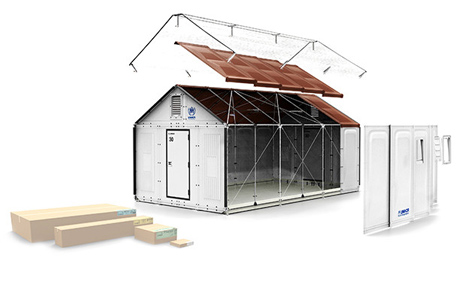
Designed to last three years, the prototype shelter from Ikea is a shed-like structure made of lightweight polymer panels, laminated with thermal insulation, which clip onto a steel frame.
The proposal has come in for a mix of comment, including the predictable scathingly negative from those experienced in the field. So, for instance, AKZ commenting in Dezeen:
"Emergency shelters designed to last months should cost about $150. Transitional shelters should cost in the range of $1,500 (as this shelter supposedly does), however they should be transitional, which means repairable by the people living in them.It is a good, succinct summary of the constraints. But a slightly more measured look at the IKEA project would actually suggest that its response to those same constraints has considerable merit.
Not many people desperate enough to use these shelters would have access to tools to fix aluminium tools (sic). Shelters should also be built by beneficiaries or at least have their input in construction in order that the shelters are valued and actually used. Not having to shift large amounts of materials across international borders also helps a major relief operation. Local materials which can be built and maintained by local people helps a shelter project succeed."
For instance, the boxy shape is explicitly providing vertical walls to encourage the addition of other external materials over time – including, I assume, rammed earth or adobe, locally sourced. Unlike many other structurally sophisticated portable shelters proposed buying vulnerable exhibitions of hopeful architecture students, this one has a primary structural frame just asking to be re-roofed with more permanent sheet materials.
I am more concerned that the proposed design may in fact have too many components that are readily repurposed as part of the inevitable economy of refugee camps and their host economies. That, after all, was the ostensible purpose of Shigeru Ban's otherwise worthless cardboard tubes – they were neither locally sourced saplings for tent poles, but denuding the countryside, nor the metal poles supplied as substitutes, but far too versatile to be confined to that function.
I wish I had the wisdom that this global problem is crying out for. One thing is clear: the IKEA proposal is not pitching into the murky waters of emergency shelter as perverse, self-promotional art objects. For a start, it is just too ugly for that. So are they just as naughtily promoting their flat pack retailing philosophy? I honestly don't think so.It is time they got involved, and I for one am pleased that they are doing so with an object on which they have obviously not sought to stamp any particular minimalist design aesthetic.