Thursday, 15 February 2018

Wonderwood

The gift material that keeps on giving

Stronger than steel? Transparent? Carbon sequestering? Positive embodied energy?  Remediative waste stream?  Sounds like a material from Marvel Comics.  But it's very likely all true.

I have written specifically about modified timber before.  In Designer materials: Helping nature? I summarized the history of treated timber, culminating in acetylated wood modification. That process protects wood from rot by making it "inedible" to most micro-organisms and fungi, without making it toxic. It also greatly reduces the wood's tendency to swell and shrink, making it less prone to cracking and ensuring that it requires dramatically reduced maintenance.  But the most surprising sustainability bonus of the product is that one of the waste products of the acetylation process is acetic acid, which is a valuable feedstock in other industries.  You can see where this is going.......

Engineered timbers are a whole other field of radical advances, including Glue Laminated Timber (glulam), Laminated Veneer Lumber (LVL) and at least another dozen products which allow designers to consider how they may substitute a renewable resource for other structural systems. But what would you be able to do if the timber itself were stronger than steel? 

That is now a fair question.  Judging by the announcement from University of Maryland, where scientists have demonstrated a wood densification technique, described in Nature, which has led to the creation of a material that is 12 times stronger than natural wood, as well as 10 times tougher.
According to Dr Liangbing Hu the timber material could be a competitor to steel or even titanium alloys, and could be used in cars, airplanes, buildings – any application where steel is used. “It’s also comparable to carbon fibre, but much less expensive.”
Earlier, Swedish researchers had already demonstrated a related technique for removing lignin from wood, to produce a a transparent material which they say could be used as windows, facade elements and even in solar panels.

“When the lignin is removed, the wood becomes beautifully white,” Professor Berglund said. “But because wood isn’t not naturally transparent, we achieve that effect with some nanoscale tailoring.”
This is done by impregnating the white porous veneer substrate with a transparent polymer.  The wood sample had a transmittance up to 85 per cent – comparable to glass.  A haze of 71 per cent is claimed to make the material attractive for solar cell applications, as light would be “trapped in the solar cell for longer”.

The researchers suggest that the modified wood could also be used for semitransparent facades, where both light and privacy are needed.  For these applications, the material "offers excellent mechanical properties, including strength, toughness, low density and low thermal conductivity.”  One on the note: given recent bad experiences with flammable facade materials, it is curious that no mention is made of flammability.

The University of Maryland group has also produced transparent – or more properly, translucent timber sheeting.  They report that their transparent wood provides better thermal insulation than glass and lets in almost as much light at glass, though without any glare – providing more uniform and consistent indoor lighting.  But to me, the most exciting news if it's true is the following claim.  Lead author Tian Li reports:
“We also learned that the channels in the wood transmit light with wavelengths around the range of the wavelengths of visible light, but that it blocks the wavelengths that carry mostly heat.”
Think about it. The reason why glass has been such an almost mystical material is that it lets in short infrared (the heat part of the solar spectrum), but is effectively opaque to long infrared (the heat would normally perceive at earthly temperatures). That is the original 'glasshouse effect' so useful for passive solar heating.

But there has always been a price to pay, where the same effect is the major cause of overheating in summer.  Transparent wood seems to have almost the opposite property of keeping the thermal loads down, while providing lots of daylight. This would be a boon any overheated climate.

The trigger for this post came from three articles in The Fifth Estate:
See
Transparent wood: the future of windows and solar panels? 
Transparent wood trumps glass on energy efficiency and light.
and
See ya steel: scientists create wonder material from wood
The research has been published in Advanced Energy Materials.

 

Monday, 29 January 2018

How do green walls actually work?


Greenery within the city has a whole range of potential benefits. These benefits include favourable impact on thermal comfort and energy consumption, improvements in air equality, establishing or reconnecting local ecologies, providing passive and active recreational space. 

How much of these benefits is realized, and at what financial and resource cost, depends on how the plant material is provided – in conventional parks, planted roofs, or green walls.

This brief note is not intended to be a definitive discussion of these benefits.  But I thought it might be helpful to expand my previous post Questioning green walls.

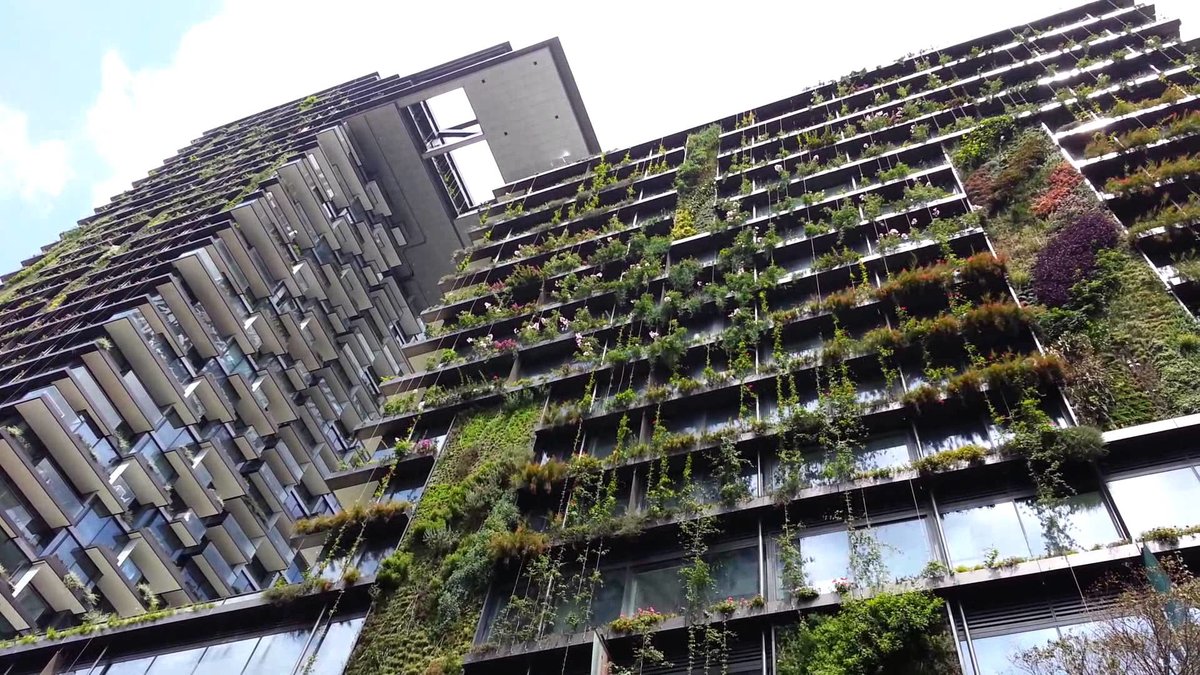
Green walls are definitely the most ‘extensive’ method of providing plant material in urban settings. The terminology is borrowed from how green roofs are categorized, where ‘extensive’ means very shallow and limited growing media, while ‘intensive’ refers to deeper and larger volumes of soil. That said,the more colloquial meaning of the word ‘extensive’ is also relevant when we are discussing taller buildings, because the area of wall generally far exceeds the available areas of roofs, and landscape areas at ground level.

Green walls therefore both resemble other settings, and have some significant differences in how they work. For instance, because of their orientation, green walls would contribute less to mitigating the urban heat island effect, than do horizontal areas of planting.


Heating and cooling energy

The contribution of green walls to the cooling energy balance of a building is complex. But to describe it simply, they:
  • provide external shading, thereby reducing the direct and diffuse solar load;
  • present a cool radiant surface facing inwards, increasing the potential for desirable heat loss in summer by outward radiation;
  • trap a cushion of air against the façade. This protected boundary layer is evaporatively cooled by transpiration from the leaves, in turn significantly lowering the conductive heat gain on hot days.
It is important to note that much of the benefit in summer is intimately related to the water consumption. The facade is effectively a complex direct and indirect evaporative cooling system.

The protected boundary layer next to buildings can also reduce conductive heat loss in winter.  But because it’s working in opposition to the evaporative cooling, this is likely to be a much smaller effect than the summer cooling contribution.


Air quality

Plants can help to reduce air pollution, by a combination of filtration to take particular to matter out of the air, and various chemical reactions to reduce the concentration of gaseous pollutants. It is well accepted that greenery in interior spaces has measurable benefits for well-being, by improving air quality. Not to mention psychological benefits, which have also been extensively studied..

But there has been some credulity with respect to claims that exterior green walls have similarly measurable outcomes for air quality.  

So it comes as something of a pleasant surprise that as far back as 2012, the journal Environmental Science and Technology reported a study which seems to support those claims.  Scientists at the Universities of Birmingham and Lancaster (UK) not only suggested that by ‘greening up’ our streets a massive 30% reduction in pollution could be achieved, but also that if we are considering urban canyons specifically, green walls out-perform street trees and other configurations of greenery. 

In short, real vegetation in cities is good for you.  But this optimism comes with an important caution:

All of this requires, of course, that the plants don’t expire in the extreme environment of today’s cities. Dr Tom Pugh, from Lancaster University, UK, said: 'More care needs to be taken as to how and where we plant vegetation in our towns and cities, so that it does not suffer from drought, become heat stressed,  vandalised, or interact negatively with other aspects of our urban areas, and can carry out the very important job of filtering our air.’

Friday, 26 January 2018

Questioning green walls


It had to happen sooner or later; green walls are being questioned.  Are they really a good thing from a sustainability point of view?

For anyone who has harbored any thoughts that external green walls on high-rise buildings might be one more expedient combination of sustainability rating 'bling' and marketing hype, a recent post in the Fifth Estate is compulsory reading.

The article quite fairly sets out the issues to be considered.  On the positive side, there is aesthetic value, heating and cooling load reduction, and contribution to mitigating the urban heat island effect.  On the negative side, focus is primarily on the overall cost, both financial and in resources, especially maintenance.

Put as simplistically as that makes it sound like negative criticism is short sighted, and another example of the ‘race to the bottom’.  But as usual, the devil is in the details.

Wednesday, 1 November 2017

Architects' little helper

How to specify photovoltaics

Note: The Architizer guide to photovoltaics is accessible again. Apparently, it was accidentally taken down and took a while to restore.

It's been getting hard for the architectural aggregator sites to differentiate themselves. And of course, how to make money from similar content. 

Sooner or later, it had to become obvious that while many forums are now talking about architecture, and usually expanding into other branches of design as lifestyle accessories, few are focusing on how buildings really get made.

One of the older such sites, Architizer, has decided to focus on this new direction:
"Moving forward you can count on Architizer for the latest trends in practice, in-depth investigations into building-products and cutting-edge news on technology in our field.
Every week we will dive DEEP into a specific building-product, exploring how to specify it, who is pushing technological boundaries with it and how it can be used to create truly incredible architecture. We will work to answer some of the most frustratingly obvious questions that architects have, that seem to never get answered — how to stop a flat roof from leaking, how to make a door disappear or how to attach metal cladding to a building."
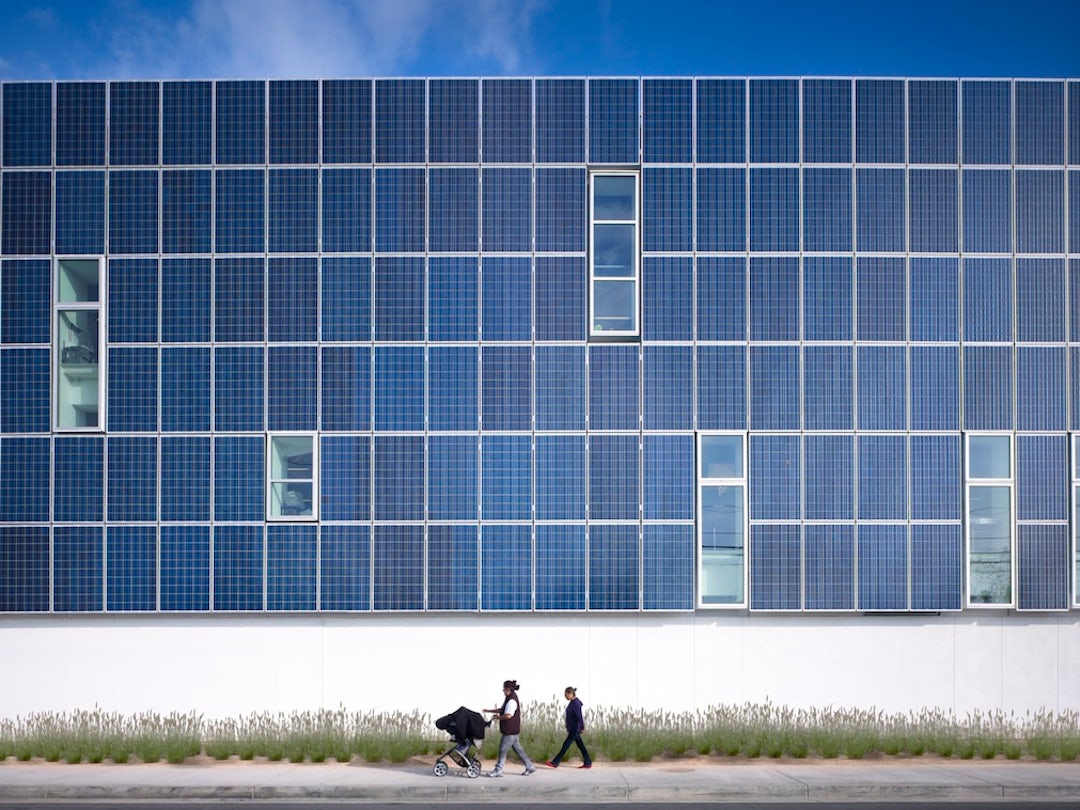
This week’s topic is photovoltaics. It is a technology that has been moving both slowly and quickly the same time. Photovoltaic panels have been available for at least 30 years. For most of that time, usually seen as the typical bolt on systems, oriented and tilted at an angle  determined by solar geometry, they have been perceived as inefficient and poorly integrated with the host architecture.

The need for building integrated photovoltaics has been long recognised.  Only in the last 10 years or so have there been enough built examples to fill a couple of case study books, and frankly, not many of the examples were particularly inspiring. But that has changed lately, with rapid advances in new materials for the photovoltaic cells themselves, and the ways of combining PV with conventional building materials.

The Architizer review article provides a convenient and timely update, with relatively comprehensive, and well-balanced technical detail.


Go to 'How to specify photovoltaics'

On that page, you will also find links to other articles in the same series.  And how do they make money out of it?  Well, if you need to, you can sign up for the Source, a service to connect specifiers with manufacturers.

Sunday, 29 October 2017

How big is small?

There is a movement called 'Tiny House'. Most published examples are gentrified versions of shacks from the past, not surprisingly, prompting debate whether these often virtuoso exercises in seductive, photogenic object design actually show us a way forward in  housing affordability.

But that's probably the wrong way to see them.

Saturday, 28 October 2017

Worth reading


I don't do book reviews......except one, over two years ago. Can I pick a winner? Sometimes yes.

I am really pleased to pass on that Chris Abel's book The Extended Self was recently unanimously voted winner of the International Committee of Architectural Critics 2017 Bruno Zevi Book Award.

As I said way back then, Abel interests me specially, because unlike most other architectural theorists, he doesn't set up an implied opposition between an architecture that does least ecological harm, and Architecture explained by some other cultural imperatives.

Read my review here.
Better still, read the book.

Today's most sustainable building. Not.

I occasionally check what Google turns up, if I just enter 'world's most sustainable building' in the search.  I am an optimist.  I expect the list to update, and the candidates to get ever closer to model sustainability.

But so far I have generally been disappointed.  Few buildings seem to rise to the top as contenders, even fewer pretenders drop off the lists.  And the terms 'sustainable' and 'green' are ever more debased.  A high LEED or BREAM or GreenStar score seems to be enough to qualify a project to be marketed with both labels.

But there is some hope.  There is a bit of polite push-back.  And it's being read or listened to, because the top ranked link in my google search tonight is actually entitled:

It's an article in Treehugger, by Lloyd Alter; not particularly rigorous, certainly not strident, an almost gentle reminder that there is more to a sustainable building than being less bad than other buildings of the same type.  Which, let’s face it, is all that a high score on one of the rating frameworks tells you.  It's an old complaint. And simply repeating it is getting almost boring.

So the other attraction Alter's article is that when he identifies shortcomings that would disqualify the Bloomberg headquarters, he actually points out examples where each aspect he criticizes has been done better.  So for instance, in relation to the claimed credit for incorporating combined heat and power:

".......CHP plants usually generate heat and power by burning natural gas. The most sustainable office building in the world wouldn't burn fossil fuels. The Bullitt building in Seattle doesn't; it has solar power and gets its heat through ground source heat pumps."


Or addressing the all too obvious lack of accounting for embodied energy:

The PowerHouse Kjørbo, an office building outside of Oslo designed by Snøhetta, was designed to produce not only more energy than it needs from its solar panels, but "generates more energy than what was used for the production of building materials, its construction, operation and disposal." It actually pays back its embodied energy.

The review does not pretend to be a comprehensive checklist for what does make a truly sustainable building.  But it is one of a series by the same author on Treehugger, which may achieve by polite conversational style what dense books and manuals clearly have not.  Worth reading.

Links:
Bloomberg HQ
The PowerHouse Kjørbo
Bullitt Center

Friday, 27 October 2017

What is sustainability?

As banal as it seems, this question came up for me recently, with just as much uncertainty as it has for the last thirty or more years.

I was one of the judges of the sustainability awards last night, run for the last eleven years by Architecture and Design, the Australian buildings and products news magazine. Before the event, it wouldn’t have been fair to the organizers or the enthusiastic participants, for me to be too negative about my experience as a judge.

But now that the awards are over for this year, the need for a full and frank discussion of what we’ve learnt outweighs those considerations.

Sunday, 7 May 2017

Lovable cities

We all know about the ranking tables that claim to tell us which cities in the world are the most livable. Melbourne, Australia, regularly tops such rankings. I suspect we also share misgivings, that what those tables tell us is nonsense.

Why aren't we talking about it more? I meant to, months ago, when I came across an article about the work of three academics at Deakin University – which incidentally is located on the margins of Melbourne.  The article leads off:
"Liveability has become one of the most important ideas to influence international urban governance and planning. On one level, this should be no surprise – after all, who can disagree that cities ought to be places where people can live? But from here things get tricky.
While debate continues on a precise definition of liveability, the idea has manufactured industry standards in empirical urban rankings based on an ever-growing number of data points. It seems timely to ask whether liveability, in its current state, tells us enough about the quality of cities as places to live."
As the authors explain, the answer to the question isn't simple. To begin with, it pays to understand who generates those tables and for what purpose? Though it's an oversimplification, most such rankings are for the guidance of corporate types, and reflect their needs and preoccupations as expatriates, rather than engaging with the sentiments of people for whom those cities are home.

Probably well aware that they are being cute, the authors set about a discussion of lovability. To quote again:

"The power of lovability is in re-engaging with people to understand the nuances of their interaction with places. Lovability is a powerful concept that, fused with other data, can cut through numbers to provide more direct, relevant information that could guide urban planning and policymaking by identifying a city’s assets through the eyes of its people. It also forgoes the increasing focus on urban competitiveness that liveability has encouraged in favour of richer and more meaningful qualitative data."

It's worth reading the original article published on The Conversation.  Short, and not too academic. The 2015 Melbourne Lovability Index Industry Report is available upon request.
The Conversation

Funny though. All the data in the world is unlikely to capture the qualities Italo Calvino does about Venice in Invisible Cities.  Or Jean-Pierre Jeunet in his love letter to Paris in the film Amélie.

Seemed like a good idea at the time

I have been interested in green walls and green roofs on buildings for quite a while. 

You could almost say that I was spruiking them – with less enthusiasm for the green veneer popularised by Patrick Blanc, and rather more for the larger scale vegetation of the 'Bosco Verticale' by Stefano Boeri in Milan.

But lately, I have been pulled up short by a very sobering thought. How safe is all this greenery if there is a fire?