The sustainability initiatives began with the main site itself, a heavily polluted brownfields wasteland. Former activities had included the city's main abattoir, as well as industries that had apparently specialized in leaking heavy metals, hydrocarbons and dioxins into the silt of the adjacent harbour bays. To rehabilitate the site involved the development of pioneering encapsulation and other strategies. The Athletes' Village was watered down by commercial development interests from its idealistic competition winning scheme, but at the time of its construction still managed to be the largest residential building integrated photovoltaics (BIPV) installation. Of course it was overtaken very quickly for that particular title, but the village did do the job of proving real estate agents wrong about the post-games marketability of smaller, better designed, more energy efficient dwellings. For the main venues, the sustainability initiatives were largely in developing analysis and evaluation tools, including embodied energy inventories of materials, that enabled the application of life cycle thinking in their design. There were lots of other smaller initiatives as well, like district grey water treatment and duplicate reticulation of recycled water.
All-in-all, it has been suggested that Sydney added a 'third ideal' of sustainability to the two Olympic ideals of sport and culture. No subsequent pitch for hosting the Games has been able to avoid credentialing its bid with claims of sustainability initiatives.Of course, one of the issues that has undermined this rosy picture, is the difficulty of maintaining a genuine use for the Olympic Games venues after the closing ceremony cheering dies away. Unless that long-term use is socially and financially sustainable, even better than normal environmental sustainability practices loose something of their cachet.
There has been a fairly grim, and relentless reporting, of just how difficult it has been for most cities to avoid the stadia and other crowd pleasers turning into white elephants. Perhaps the worst is Greece, where the financial crisis has resulted in funds for maintenance being withdrawn, and venues literally abandoned.
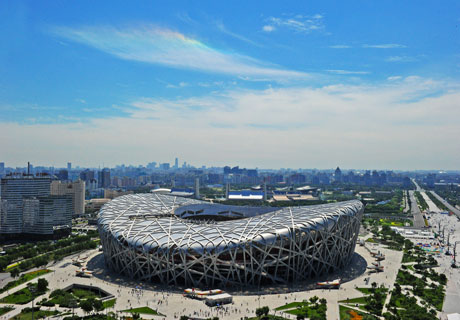
My interest in this issue was given a nudge when my Chinese speaking partner mentioned a Taiwanese video which extols the success of the Bird's Nest Stadium in Beijing, in hosting a sequence of varied events, and the technological wonders the venue provides to make it all possible. Very large amounts of money as daily rent are mentioned, as well as the suggestion that the venue is booked out through 2015. This did not seem to accord with my memory of other discussions on the internet. My first reaction was that all those articles disparaging the post-games use of the stadium were probably a subtle form of anti-Chinese sentiment, perhaps dangerously out of date with reality.
At first, I thought I had guessed right. Most googled links seemed to be dated 2009 (the year after the Beijing Games), and like a lot of the blogosphere, they seemed to repeat the same few snippets reporting a disastrous lack of bookings.
But after a while, my collated list of events hosted by the Bird's Nest over the four intervening years started to resemble the ones breathlessly touted in the Taiwanese daytime TV show. I realized again that you can't believe a lot of what you see on the internet, and that daytime TV anywhere is mainly a totally unreliable mashup with a bent towards sensationalism, when they run out of conspiracy theories. In this case, they managed to put an editorial spin on a bunch of images, that made it look like technical miracles were performed to change overnight from a football pitch to a car racing track, from competitive skiing on artificial snow to a rock concert. The reality seems to be that an initial interest by local tourists has dramatically waned, with the 50 yuan entry charge too much for many visitors, and the big events few and far between, with any but the rock concerts and Italian league soccer games failing to fill the 98,000 seats. The revenue falls well short of the outgoings.
It's thought provoking what other factoids turn up. For instance London's stadium is a deliberately 'temporary' structure, that uses only 10,000 tons of comparatively 'ordinary' steel, compared to 42,000 tons of never before seen alloy needed to hold up Beijing’s Bird's Nest. That would seem to be a telling comparison of embodied energy and other normal sustainability metrics. But it's hard to be confident of such information even from an engineering trade site, given the same article quotes the circumference of the stadium in square feet, and passes without comment over listing PVC coating on the retractable fabric roof.
What, if anything, can one conclude? With considerable certainty: sustainability and the Olympics is an oxymoron. Even if it does have some identifiable effect on tools and design practices employed by building professionals, and possibly sends some positive messages to the general public, the rhetoric is shameless greenwash.
Links:
- The original video is at http://vtwtv.biz/forum.php?mod=viewthread&tid=45885
- The closest to believable single article about bookings for the Bird's Nest I found on a quick search was Caixin Online Empty Nest Syndrome for Post-Olympics Beijing
