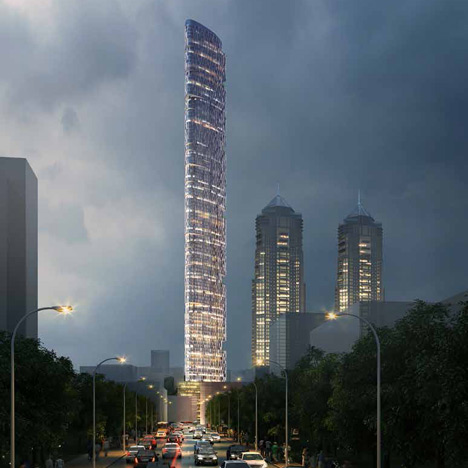
 Dezeen today runs with the announcement that Adrian Smith + Gordon Gill Architecture has unveiled its competition-winning proposal to build Mumbai's tallest skyscraper. At 400m, the 116-storey Imperial Tower would become the tallest building in the city. The architects are an obvious choice. Their kilometre-high Kingdom Tower in Saudi Arabia is currently under construction.
But this post is not primarily about the merits of very tall, high-tech apartment buildings in densely populated cities in the developing world. That topic does deserve discussion, of course.
My concern in the here and now is, as usual, the deplorable quality of technical description that is included in these barely editorialised bits of prostituted journalism, which populate the plethora of designpop sites.
So, for instance, the breathless description: 'the tower would have a slender, aerodynamic shape designed to "confuse the wind" and withstand strong currents. . . Green terraces called "sky gardens" would also break up wind currents, say the architects . . . 'Give me a break. Looking at the images, and taking them at face value, it first appears that the architects and engineers are going out of their way to create an aerofoil. If so, you would expect wind flow to remain laminar, and actually to exaggerate lateral forces on the very tall building. Which is the very opposite of the so-called 'buff' shapes of most buildings, which do indeed tend to break up that laminar flow and create considerable turbulence as the wind passes around the tower form.
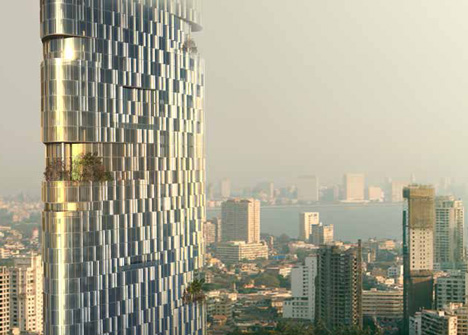
The blurb about the other sustainability features is similarly inane. What process water do you recover from cooling towers, if a majority of the extraordinarily extravagant apartments are conventionally air-conditioned? If the discussion about water is to be meaningful, we would need to know how the architects and engineers found an alternative way of heat rejection, how they maximise harvesting rainwater at the times of the year when it is distressingly plentiful (during the monsoon), and how, if at all, water is stored on a seasonal timescale – something I have not heard anyone attempt on a constrained urban site with a very tall skyscraper.
Every player in the process conspires to keep it that way. Marketing blurb put out by the architects to bolster their business before news of actual performance of the building can catch up with the rhetorical claims. Lazy and technically inept architectural journalism, repeating ad nauseam the same press releases. And an engineering literature that is so carefully hidden away that it takes seriously hard work to top up the scant and useless technical information available on most architectural projects. I despair.There is a small difference between providing useful information, and that which is partially useful but dangerously misleading. But as I have repeatedly commented, in architecture the latter is the chronic status quo.
Read the original article here.
