Showing posts with label parametric architecture. Show all posts

Monday, 26 August 2013

Architecture that works

There is low level disquiet, and there is enthusiastic hope.  There is trenchant distrust, and over-the-top spin.  There is an entrenched profession of older architects, trained in craft and the relatively easy-to-digest theoretical aphorisms of mainstream 20th century modernism.  And there is a younger generation, also trained in craft, but that of the computer produced image, for whom architectural theory has been more about obfuscation than certainty.

The older generation, many of whom operate as sole or small scale practitioners, and still struggle to adopt 3D CAD into their design and documentation workflows, are profoundly suspicious that the advances in digital technologies already impart the power to produce any shape, any material assembly.  And that such power corrupts architecture, absolutely.  For them, the apparently undisciplined excitement of contemporary emphasis on extravagant external form is not architecture at all.  There is a moral tone to that judgement.

The younger architects, now produced by universities in numbers guaranteeing that they will be underpaid and overworked for most of their careers, know rather more about the true consequences of so much computational power.  And there are enough champions of the possible, to make it seem like a revolutionary change is occurring in our relationship to the built environment.  True parametrics are seen as capable of increasing the cognitive span of the master architect.  But the euphoria is tinged by the knowledge that BIM will consolidate production of more and more complex buildings by smaller and smaller teams, requiring fewer employed architects. At least some of this generation are also intensely self-conscious of the loss of empirical building experience from their education.
Of course, it isn't as simple as this binary generational stereotyping.  In particular, the star architects who actually get to build the most visible and most influential form driven buildings are almost all in their sixties, or older. And most of the small firms publishing smaller projects in international digital blogs and zines – in numbers that were the stuff of dreams in the old print media days – seem intensely focused on the material finesse of their work, and lionize older masters of craft like Peter Zumthor.

Be that as it may, the ground is fertile for the re-emergence of architectural manifestos. It seems necessary to make sense of change, while condemning the ease with which it is embraced.  And so it is that New York City architect Curtis B. Wayne has launched his little red book The Shape of Things that Work: The Fourth Architecture, with the avowed purpose of  saving architecture from the current orthodoxy of form-making over substance, or “sculpture you can live in".

Guy Horton, writing a considered review in his 'The Indicator' column on archdaily. summarizes it thus: "in Wayne’s conception, the First Architecture is the Hellenistic, the Second is the Gothic, and the Third is the modern – up to and including our contemporary, formal experimentation with software".  For me, that is immediately problematic, not because a case may not be made for the first two, but because any attempt to argue the third (in order to make way for the fourth) is patently absurd.  And so it seems indeed, if the examples Wayne cites as his paradigms are anything to go by.

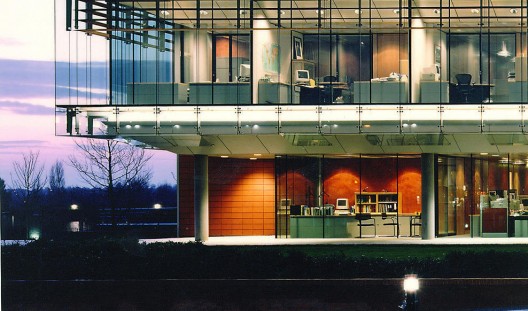
“The integration of functional form with the beautiful is as elusive as a conclusive definition of beauty itself,” says Wayne, seeking to explain why there are so few examples of successful Fourth Architecture candidates. He suggests George Fred Keck’s Crystal House, RMJM’s Glaxo-Wellcome building, and the Helicon Building by Sheppard Robson Architects.  I only manage to agree with him on Glaxo-Wellcome, and then only if I willfully ignore the limits the architects placed on properly evaluating the project's actual performance, in order to arrive at its unreconstructed modernist aesthetic.

To narrow his definition, Wayne suggests that buildings that have sensor activated flaps and stuff, like Morphosis' Cooper Union Academic Building, are not 'The Fourth Architecture', apparently because the mechanical bits have failed.  I guess that knocks off Nouvell's Institut du Monde Arabe in Paris, too, in spite of its remarkable urbanism. Yet it's hard to spot the conceptual difference, if we are to accept that Wayne is more positive about the HeliOptix Integrated Concentrating Solar Façade developed as part of the proposed design by SHoP Architects for New York’s Fashion Institute of Technology.  Let's face it, it's quite possible that the only reason it isn't on the list of refuses, is that it hasn't failed, yet.

But I make it sound like I disagree with Wayne's central thesis that "true architecture is missing when form-making takes precedence over function and performance". Actually, I don't.  I agree with him wholeheartedly.  I wish I could write a manifesto that actually changed the world, and if I could, it would share a lot of themes with Wayne's.  It would be a paean for a simpler architecture, that works.

My problem is that while my thinking is reductionist, my sentiments are far too pluralist.  Not to mention that I happen to think the last wave of manifestos were probably to blame for where we are now.  Think machines for living in, and rhetorical makeovers for Paris now coming true in Beijing or Shanghai or Gargaon.  I don't think the truth is out there.  But I know what I like.

Read Horton's review in 'The Indicator'. 

And if you think Wayne's little red book is likely to make sense of the world, by all means, read it too.  A decent didactic critic can't be worse than most of the drivel architects write about their own work.  It's in very big letters on a very short 100 pages or so.

But be warned.  In the end, Wayne is fundamentally concerned that buildings should look like they work, and never really transcends the 'form follows function' rubric.  He even uses the phrase.  Never mind it was debunked comprehensively as long ago as David Pye's Nature and Art of Workmanship of 1968.  Download a PDF copy, quite legally, here

Wednesday, 13 March 2013

It's probably architecture

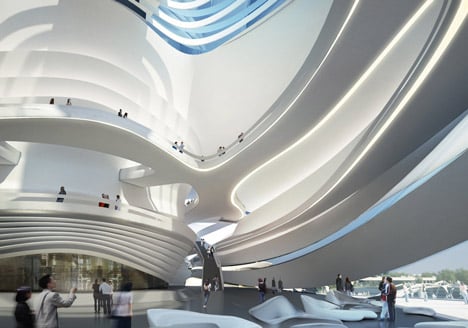
The latest large scale work by Zaha Hadid to feature heavily on archi-pop sites such as Architizer, Dezeen and ArchDaily is the Changsha Meixihu International Culture and Art Centre.

Architizer's headline Zaha’s Changsha “Megaplex” Is More Zaha Than We Can Handle hints at the possibility that this project, more than any other, might represent a tipping point.  But the actual tone of the article is sober and supportive, confining itself to a narrative that does no more than describe the formal development of the major components of this large complex.

In some respects, the published images indicate an architecture like many other proposals, by many other architects.  These works are clearly the products of visualisation software, and of the plastic sculptural freedom such software affords anyone who can lay out a rudimentary circulation diagram.  The illustrations are 'scaled' to human experience, by the same simple expedient as has always characterised architectural drawings: inserting the human figure in poses vaguely identified with the building program.  Any concern about the realism of the images as representing buildable prototypes is in the first instance answered by the now common knowledge, that the illustration software captures underlying geometric data which can be fed with little further mediation to fabrication software, in turn capable of controlling machines that automatically deliver suitable components at building scale.  There is no doubt that such buildings can be, and are being built.

So, do they represent the current parametric zeitgeist, a logical evolution of architecture outgrowing the artisan niche to which it was formerly adapted, or are there some other theoretical and practical implications that should be getting a better run in discussions on these sites?  Again, the first reaction might be that more profound theoretical examination is to be expected in the scholarly settings of books and academic journals.  Fair enough on the face of it, but a bit of a cop-out.

Even casual examination of the renderings suggests that their authors are simply not engaged in any rigorous anticipation of the built reality.  It isn't that hard to comment on the absence of material clues in these otherwise photorealistic renderings; the absence, rather than the dissolution of clues to what is inside and what is outside, the missing distinctions between surfaces formerly characterised as ground, wall, or sheltering roof.  More generally, this lack of coding of the layers of design intent leaves unanswered other profound questions relating to the life of the building, including how it actually achieves comfort and amenity, and whether it relies on sustainable supplies of energy to fulfill its most rudimentary functional tasks. The architects appear to be leaving that all to be somebody else's problem.

It is not a stretch to suggest that buildings like the Changsha Meixihu International Culture and Art Centre are the result of a relatively recent realisation – that really, almost anything is possible.  But is it good for us to leave that proposition hanging, without self-imposed constraints and qualifications?  Surely the theoretical discourse takes on an ethical dimension, in which even populist on-line magazines can engage?  Something to do with whether imposing on others the consequences of such wanton profligacy should be the dominant paradigm of public architecture?

Of course, there is much more to interrogating the theoretical underpinnings of an architectural proposal, than asking whether it is right or wrong to stretch budgets.  For me as a teacher, the implication of 'anything is possible' has very particular, everyday consequences – and many might be surprised that they are almost all negative.  Imagine trying to maintain a shared critical framework with a student, in which to communicate that not all is right with his or her developing studio design.  If students are seduced by Zaha in her 'anything is possible' mode, they have little incentive to accept such a critique.  While the concepts of 'right' or 'wrong' are contestable, to have no such concepts makes learning very difficult.


Friday, 7 December 2012

Slow architecture

Not so much purposefully, but neither aimlessly surfing for solar and shading software, I came across Gnarly Architecture, a blog by Brian Lockyear of Slate Shingle Studio in Oregon, USA.  Brian describes himself as "a digital voyager with an artistic temperament and an eye for both the sublime and the quirky", and I'm happy to agree with his self-assessment.  For anyone who wants to turn a general fascination with the sometimes dangerous world of parametric architecture into something useful, Brian's blog is compulsory reading.

But the entry that stopped me in my tracks, made me smile inanely, and which I have immediately linked to my First Year coursework site for architecture students at UNSW, is Passive Aggressive Solar Design.  Brian describes it as:

Passive Aggressive Solar is about creating magical spaces by actively considering solar movement in the design. It’s about a window seat and a book at sunrise. It’s about a shady spot at noon. It’s about framing the perfect sunset. At its best, Passive Aggressive Solar is about moments no longer than the time it takes a rainbow to appear and disappear.


He argues convincingly for a healthy synergy between computational analysis now possible to predict exactly the complex geometries of sun movements, and the traditional craft sensibilities of a masterful architect.

Finally, he proposes "a “slow light” approach to solar design, in which we take the time to think about each opening in a space and how it contributes to the magic. Why not use the sun to incorporate movement into the design but on an architectural scale – somewhere between the speed of a waterfall and the stealth of a glacier."

How can you argue with that?  Read the full posting here, and savour the last paragraph.