Saturday, 2 May 2015

Anything but superficial

A portrait of failed criticism


Under that clever title, Architects Without Frontiers chief Andrew Mackenzie reviews recent commentary in  ArchitectureAU, on ARM Architecture's Portrait building in Melbourne, Australia.  He finds the critical discourse 'marred by racial profiling, pedantry and unsubstantiated opinion'.  And I have to agree with him.

As often happens, the best thing I can do is point you at MacKenzie's excellent and readable article.  Click here to access.

But it's worth adding a little more information not highlighted in MacKenzie's piece.

Saturday, 18 April 2015

Voodoo heliostats

Oh, the magic of the big architectural gesture!!! 

By far the most read of my blog posts are those about Nouvel's iconic carbuncle on the face of One Central Park, here in Sydney.  It is clear that there are a lot of people interested in that big and mysterious heliostat.

But what really amuses me is that it seems to have raised expectations more broadly.  Quite clearly, some people think that such technical gymnastics will also solve otherwise impossible architectural or urban design problems elsewhere.

Sunday, 22 March 2015

The most sustainable building is an existing one

Nothing new in this post.  I just can't help myself; I am becoming more and more committed to driving home this particular message. I sincerely believe that the principle holds, regardless of what else might come into play, if we truly strive for a sustainable built environment.

For sake of simplicity, let's get the definitions right.

Monday, 16 March 2015

Real parametrics


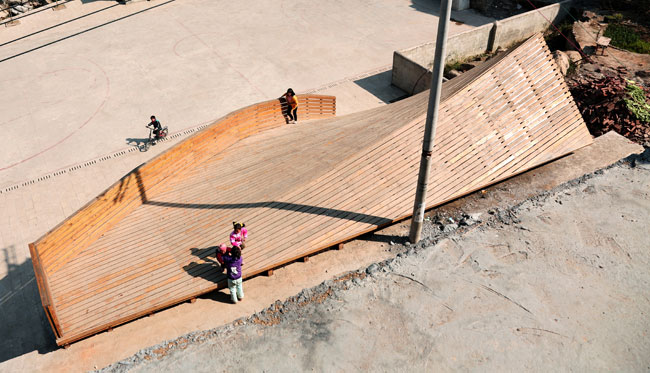
Sometimes you come across a project that re-establishes your faith in the purpose of architecture, while it also accommodates the architects' in-group preoccupation with interesting forms which dominates the mainstream literature. This little project is one of those classic NGO interventions – in a place where almost anything is valued, but where something good adds immeasurably more value. 

Friday, 13 February 2015

Biased critic


My post on Gehry's Sydney building prompted some off-line correspondence.  That discussion inevitably involved comparison between the 'starchitects' and their apparent disregard for the usual constraints to which the rest of us have to pay attention....like cost, or durability of external finishes.


It highlighted that I find myself in a very strange frame of mind in relation to these various 'starchitects'.  Because they are all so bloody talented at something, it is all the more offensive how cavalier most of them are. 

Saturday, 7 February 2015

Rational Gerhy, rational critics


The paper bag opens


With much brouhaha, in the presence of the celebrated architect, Sydney's one and only Frank Gehry building was opened  this last week. And the opening was accompanied by the same vehement, self-serving misinformation that has been dished up about it during its construction. It's the building that people love to hate, but they are too lazy to really think about.

Typical was the rant by Elizabeth Farrelly, Sydney's resident public intellectual architecture critic. Before I quote her, let me be quite clear: I am really pleased that Farrelly can survive by her writing, and she has every right to a fairly held opinion. I am even more pleased that Gehry's building prompts Sydney people to be interested in architecture, and to debate it. So what does Farrelly have to say?  First ad hominem, attack the man:
"Frank Gehry is the Kim Kardashian of contemporary architecture: all curves, no content."

Sunday, 25 January 2015

Architects should do nothing

Remember the outrage when Zaha declared that workers dieing on her projects in Qatar had nothing to do with her?  Or when her loyal lieutenant Patrik Schumacher took to Facebook with his inane rant: "Architecture is not politics not art not science not engineering. It is the design of communicative spatial form....what we communicate....is NOT up to the architects"?


In this blog at the time I joined the incredulity.  But I almost feel like an apology to those two, having come across an earlier declaration by Peter Eisenman in an interview by David Basulto on ArchDaily in 2011:
I don’t think that architecture is about solving human problems at all. Psychologists solve human problems, sociologists solve human problems, economists solve human problems. We’re none of those things. We do culturally necessary projects, which have a value for the culture in general. What should the architect do in society? I don’t think the architect should do anything, frankly”.

Friday, 23 January 2015

Roll over Bruno Taut

I never did understand the social implications of 'die Stadkrone', or 'City Crown' as a concept of urban planning put forward by German expressionist architects, and particularly championed by Bruno Taut in the early part of the 20th century.  As Wikipaedia helpfully summarizes: 'it was often conceived as an inspirational, crystalline form or something with a homogenous formal vocabulary in the centre of a town, with huge impressive scale, analogous to, but not necessarily Skyscrapers. The physical forms were notions of social restructuring with subordination of individuals to the collective good and sometimes ideas of a return to an agrarian existence'.

So I am suitably bemused by developments in the City of London. If a recent piece in Architizer is any guide, they are definitely on the way to realising Taut's vision .

Thursday, 22 January 2015

Zombie energy efficiency

Explosive report lifts the lid on Australia’s building energy performance sham

Energy efficiency in the home building sector in Australia has been dead for some years.  It just puts on a brave show that it isn't. 

Read this if you care.  It's not pretty, but it's important.

Friday, 16 January 2015

Murcutt is famous enough.....

 ....without gilding the lily.

I honestly don't know what motivates journalists on architectural websites. But I know that when they try to talk up the technical virtues of famous architecture, more often than not they cause more damage than good.

A recent example is an article in Architecture and Design by