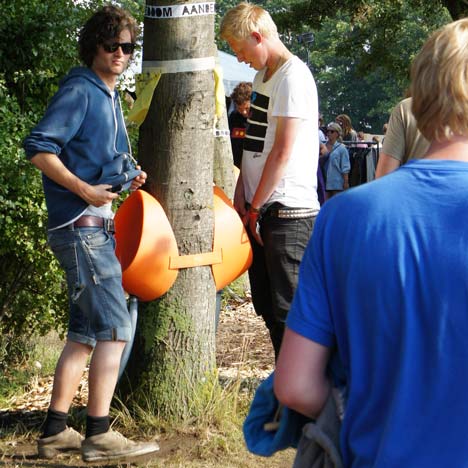
Back in 2010, The P-Tree by Dutch designers Aandeboom turned up on inhabitat as a prototype. In 2011, unable to prevent revelers urinating against their trees, the Roskilde Festival in Denmark installed the tree-mounted urinals. The P-Tree is ingenious in taking pressure off porta-potties at public events, but suffers from still having to be connected up to either the main sewer or to a local treatment installation.
We didn't have to wait long for the next logical development. An outrageously simple outdoor urinal by French design studio Faltazi slots into a straw bale to recycle pee from festival goers into compost. L'Uritonnoir is a cross between a urinal ("urinoir" in French) and a funnel ("entonnoir"), and comes in two versions – the flat-pack polypropylene DIY model and the stainless steel Deluxe model.
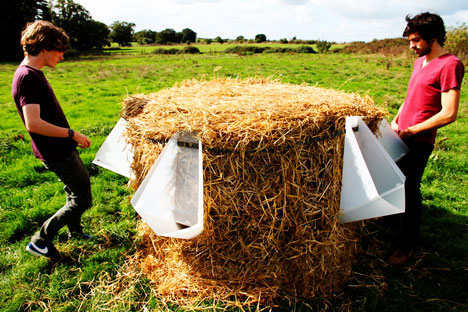
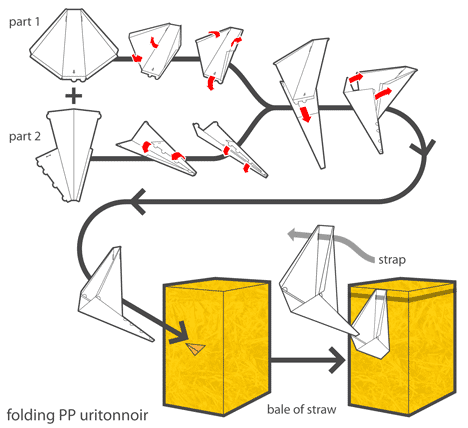
To set up a urinal, L'Uritonnoir is pushed into the side of a straw bale and fixed in a place by looping a strap through its top holes. As the bale collects liquid, nitrogen from urine combines with carbon in the straw and starts a process of decomposition. After use, the bale can either be taken to a local composting facility or left on the spot for six to 12 months to become compost, before being scattered on the soil or used as a planter.
I like it.
See the manufacturer's site here.
Or a very good set of images and full description on Dezeen here.
Dezeen also has the best coverage of the P-Tree here.
We didn't have to wait long for the next logical development. An outrageously simple outdoor urinal by French design studio Faltazi slots into a straw bale to recycle pee from festival goers into compost. L'Uritonnoir is a cross between a urinal ("urinoir" in French) and a funnel ("entonnoir"), and comes in two versions – the flat-pack polypropylene DIY model and the stainless steel Deluxe model.
To set up a urinal, L'Uritonnoir is pushed into the side of a straw bale and fixed in a place by looping a strap through its top holes. As the bale collects liquid, nitrogen from urine combines with carbon in the straw and starts a process of decomposition. After use, the bale can either be taken to a local composting facility or left on the spot for six to 12 months to become compost, before being scattered on the soil or used as a planter.
I like it.
See the manufacturer's site here.
Or a very good set of images and full description on Dezeen here.
Dezeen also has the best coverage of the P-Tree here.


