Friday, 26 December 2014

Feeling really really guilty

Along with most people I know, I was really amused by a clip of Pakistani building workers driving piles by bouncing up and down in time to a suitable Bollywood tune.  I linked it as an example of ingenuity, in a post which actually featured a colleague's use of a team of workers to do a structural 'Excitation Test' on a Gulf building site.

What I forgot was that the funny clip is in reality the mask for horrific practices on building sites in developing countries.  I think more people ought to know.  Architects in particular should do what they can to eliminate these barbaric ways that people are used and used up.

Sunday, 21 December 2014

Touching the earth lightly

The phrase was irrevocably appropriated to describe the work of Pritzker Prize winning Australian Architect Glenn Murcutt.  Which is a pity.  Not that Glenn's houses on the whole don't deserve the description.  Rather, because the work of some others may deserve it just as much.  Or, more subtly, because to identify the phrase so closely with a particular spindly shelter on pad footings, may actually do a disfavour to other approaches with less impact on the natural world.

I was reminded of this, by this year's winner of the Best Building in the World at the World Architecture Festival, the Chapel on the outskirt of Ho Chi Minh City, Vietnam, by local architecture practice a21studio.

Saturday, 20 December 2014

That heliostat again: enough already.

Now that Jean Nouvel's One Central Park apartment building has been invested with the exalted status of “Best Tall Building Worldwide” by the Council on Tall Buildings and Urban Habitat (), it's time to put that infamous heliostat to bed.  Especially as it hardly got a mention in the metaphorical shadow of the breatless claims for the world's biggest, ot tallest green walls by Patric Blanc.

Up front:  The heliostat works as described in an earlier post in this blog.  See the diagrams and descriptions at "Clued in on the heliostat".  And a video here. No, it doesn't do anything to improve winter sun for the apartments at all.

Friday, 19 December 2014

Overwinding the clockwork city

Now that Dan Hill is back, based in London as executive director of Futures at the UK’s Future Cities Catapult, he also seems to be back to posting more incisive critiques of our urban futures, based on his specialty in 'urban informatics'.  It's what he used to do so well on his blog City of Sound,  I got pretty irritated at the more social chit-chat while he headed Benetton's Fabrica, the communications research centre and transdisciplinary studio in Treviso, Italy.

So I am back to reading him.  This article is the in-depth version of an 'Opinion' column posted in Dezeen earlier this year, around the impact of predictive analytics on cities.  Hill develops a proposition that contemporary 'disruptive technologies' may be bad for society.  His central argument for all intents and purposes concentrates our focus on the lack of social contract between startups and most societies, and how they can therefore pick off the services that are the most lucrative, without any obligation to maintain equitable access for all.  Simply put, Hill argues that the greater access is not better access.

Effortless good maners: Paris Underground

There is a class of architecture, which – when possible to be used – solves in a fully integrated way most problems of sustainability, as well as good manners in responding to sensitive contexts. It is not expensive to build, and often affords freedoms which most conventional ways of building do not offer. In spite of its simplicity, robustness and other clear attractions, it is surprisingly rare.

I have been a long-standing fan of underground or at least earth sheltered buildings.  Depending on your definitions, this mode of construction is either rare, or quite the opposite, almost everywhere.

Sunday, 2 November 2014

Best wishes


5 X 4

A tiny plot of land in East Melbourne’s Hayes Lane measuring only 5m by 4m will be home to a project whose formidable scope belies its diminutive size.

So runs the byline of the article in Ecolibrium, the admirably accessible print/online journal of the Australian professional association for people involved in the heating, cooling and refrigeration industries.  I really like AIRAH.  A bunch of engineers whose livelihood depends on selling new air-conditioning systems, actually does a much better job at keeping up-to-date on how to avoid it, than do my architect colleagues. The article on this little project is a typical example.

Wednesday, 29 October 2014

Picking up after Frank

Frank Gehry says today’s architecture is “pure shit”*
 

You have to agree with him, of course, but with a very important caveat.  Based on the quotes, Frank actually did suggest that what he means is different from what his tired off-the-cuff comment sounds like.

The fundamental problem is that ARCHITECTURE is, if you like, the figure that needs to exist against a background.  If so, then as Frank infers it should be architectural art brought to bear on the important monuments and landmarks of a city – a city that is otherwise made up of buildings more subservient to their role as the necessarily self-effacing setting.  Such 'background buildings' might be made by architects, but more in the tradition of a vernacular.  In other words, architecture is not defined simply by the fact that it was designed by a journeyman architect.

If that proposition holds, then Frank is describing a situation particular to architects and their values in the contemporary era.  The profession and the schools today make every architect aspire to differentiate every building as if it is ARCHITECTURE, and demean the relative anonymity of the journeyman building.  That makes every outwardly self-promoting building (other than appropriate monuments and landmarks) bad architecture.  Because such buildings are the major proportion of contemporary architectural production, Frank may well be right in his estimate of 98%.

So what is a journeyman architect to do?  I would say concentrate on making the experience of ordinary buildings continuously delightful, pleasantly surprising at the level of intimacy that affirms everyday life.  Every such building, done well, can contribute to wellbeing, and more.  A good school room can enhance learning, a good hospital can accelerate healing, a good workplace can promote cooperation while achieving greater productivity, a good apartment can make you feel special every time you walk into it. That sort of architecture requires very significant knowledge and skill, but also requires a certain humility.

That Frank is not humble in response to an innocent but poorly thought out question, should not detract from his essentially incisive reflection on a profession that should be.

*  The headline is from Architecture and Design, but the press conference in Spain is widely reported.  Read The Independent version, here.

Friday, 17 October 2014

Zombie architecture

Keeping it cool: how Melbourne’s Council House 2 took advantage of the night

That is the headline of a large article in Architecture & Design, on 16 October 2014.

I don't want to poop on their parade, but the article on CH2 repeats uncritically the descriptions of what the building was designed to do, not what the performance actually achieves. In particular, it is a rewrite of the 30 June 2013 post in Archdaily, which was already criticised in its comments for not providing more recent information on achieved performance.

The authors of both articles are either unaware of, or deliberately ignore the study commissioned by the City of Melbourne in 2012, by Paul Bannister of Exergy*.  A long article reporting the study was published in the AIRAH magazine Ecolibrium, and is downloadable by anyone.

The commissioning and design of CH2 was a brave initiative by the City of Melbourne, to explore and provide an example of better performing, healthier commercial office developments. 

Thursday, 16 October 2014

Apartment Design Guide: Update

This may be of very parochial interest.  I have previously posted about various aspects of the local planning approvals regime here in my home state of New South Wales, Australia.  We have a particularly powerful policy and model code relating to apartment buildings, which has been very influential, but which has been overdue for a proper review.

In Review of SEPP65: Design Quality in Residential Apartments way back in 2011, I described the first stage of that review, and linked the working papers.  Then everything went quiet.

Finally, and quite suddenly, a draft of the revised model code has been released, with no explanation of the reasons for the delay.  My personal opinion is that the proposed revised code, now renamed the Apartment Design Guide, contains enough flaws that if released it will actually cause more problems than continuing use of the older version it would replace.

For the moment, I will not write in detail about my concerns, but I thought it important to post the otherwise hard-to-find link to the download.  For anyone seriously interested in apartment design, it is an interesting resource.  For anyone in NSW actually developing or designing apartments, it is critical to look at, and possibly to contribute to the feedback during the 'exhibition period'.

Download the Draft Apartment Design Guide, together with some related documents, at
Improving apartment design and affordability_ State Environmental Planning Policy No 65(5).

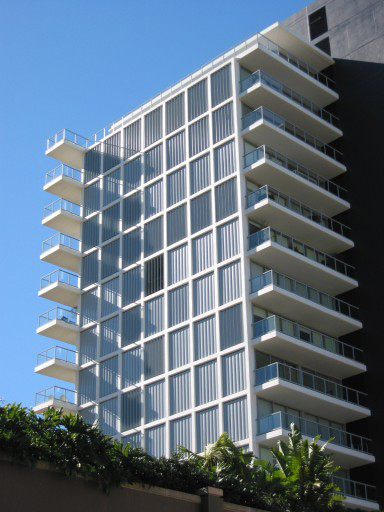
By the way, the headline image is the Altair Apartments, judged at the 2002 World Architecture Festival as the 'Best Housing Scheme in the World'.  And indeed, at its best, SEPP65 and the Residential Flat Design Code have been credited with producing a significant transformation of the Sydney apartment building standards.  See my previous posts:

Monday, 13 October 2014

Looks good, doesn't work

The Folly of Building-Integrated Wind

That was the title of an article in Building Green back in 2009.  As author, and most prolific contributor, Alex Wilson said at the time:
The appeal of integrating wind turbines into our buildings is strong. Rooftops are elevated above ground, where it’s windier; the electricity is generated right where it’s needed; and wind energy can make a strong visual statement. Dozens of start-up wind turbine manufacturers have latched onto this idea since it fits well with a strong public sentiment to shift from fossil fuels to renewables....What’s not to like about it?